Showing posts with label Poignant. Show all posts

Saturday, April 10, 2010

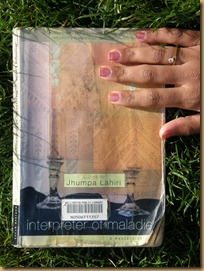
Interpreter of Maladies – Jhumpa Lahiri

480
It almost seemed like a lifetime since I had read a collection of short stories. I was also looking forward to reading a book set in India to partly quell my nostalgia, but partly to give my readers a spicy, aromatic taste of this exotic land. Interpreter of Maladies just seemed to fit my bill and so I set about perusing it. In the end, I was left with some mixed feelings about the book.
 
Interpreter of Maladies is a motley collection of nine tales travelling between the frigid New England winters to the bustling city of Calcutta in India. There is a strong undercurrent of love and longing welling up in her characters, some for their homeland, while still others for the life that once was, with the familiar stranger that they have grown used to. Through these stories, Lahiri has tried to capture the feelings of awe and fear that passes through an immigrant’s mind as they travel the seas to a land far removed from their own. All the tales are heavy with an air of poignancy, typical of Lahiri.

Lahiri is definitely a good writer with her vivid imagination and accurate depiction of her characters. It is because of this latter trait that the reader becomes quite attached to most of her characters, although they are only available for twenty or so pages. I liked her knack of bringing unlikely people together in a relationship that seems to extend it’s arms of friendship, while making strangers out of once-upon-a-time-lovers. She has brought our attention to the strangeness of the human mind when a woman cannot tell her husband some bitter truths about their relationships but can do so to someone she has met for only a day, for precisely that reason.

However a few stories like ‘This Blessed House’ and ‘The Treatment of Bibi Haldar’ seemed to have been stretching on forever and in the end, revealed themselves to be quite pointless.
 
Interpreter of Maladies is a decent choice if you are looking for a collection of stories to read.

Book Rating – 3.5/5

Book Stats:-

No. of Pages:- 198;
Year Published:- 1999;
Publisher:- Houghton Mifflin Company
Book Setting:- US, India;
Reading dates:- 05/Apr/2010 - 07/Apr/2010

Stories in my order of preference:-

  • Sexy
  • A Temporary Matter
  • Interpreter of Maladies
  • When Mr Pirzada came to dine
  • Mrs Sen’s
  • The Third and Final Continent
  • A Real Durwan
  • This Blessed House
  • The Treatment of Bibi Haldar

Other books by Jhumpa Lahiri that you might be interested in:-
image  image

Watch out for my next review from the exotic Caribbean island of Jamaica, A Long Song by Andrea Levy, the tale of a 19th century slave and her owners.

Monday, April 5, 2010

Broken Verses – Kamila Shamsie

483
After reading Burnt Shadows by Kamila Shamsie, I was so taken in by her elegant writing style that I could not stop myself from picking up Broken Verses. Kamila has revealed yet again the artful story teller that she is. If a book can move you to tears, then surely there is something much more to it than just a story.
 
The protagonist, Aasmaani Inqalab literally meaning Celestial Revolution, lives in the seaside city of Karachi, where she flits from one mundane job to another so she can remove any spark of the person she once was willing to be, a person who thought she could change the world. Born to a highly unconventional activist mother and a regular banker, Aasmaani, since her childhood has been embroiled in conflicting worlds, an idealist world of protests and poetry which belongs to her mother, Samina and her lover, The Poet, and the pragmatic comforting world of her father and his family. Aasmaani, who cannot come to terms with her mother’s disappearance, has been conjuring up images of her glorious return the past fifteen years. She is so caught up in thinking she has never been good enough for her mother to stay, that she fails to see the people around her reaching out to her and trying to pull her out of her shell, including her half sister Razia and her colleague Ed. It remains to be seen whether Aasmaani does loosen up as this riveting tale draws to a close.
 
A literary feast, a political fiction, a tale of passionate love, the story of a person torn between her role of lover and mother, I cannot even begin to categorise what Broken Verses is all about. Kamila etches out her characters so vividly that the reader soon becomes engrossed in them. In a nation, at a time when one cannot even say the word democracy loud enough for fear of getting caught by the minions of the government, Samina fearlessly dons the activist garb and you find yourself wondering through Aasmaani, whether she stops being a mother when she starts becoming an activist. When she takes her beloved in her arms, is she any less of a mother? These questions torture the reader as Aasmaani goes through her life not being able to let go of any hatred as she imagines herself to be the girl whom her mother has left behind over and over again.
 
The sea speaks out to you through The Poet’s muse, which is a passionate rendition of his love for Samina. Their love is beyond words that, it is little wonder that everyone who loves Samina, including Aasmaani, feel they are competing with a force they cannot reckon. I loved Kamila’s portrayal of the quiet courage and determination of Bheema, Aasmaani’s step mother, who fights battles everyday at home for the sake of her family, which are no less courageous as compared to the battles fought on the street for the sake of the country.
 
I enjoyed reading the book thoroughly, although, I wish it had ended differently. But I quickly brush aside that thought as the book has too many merits to be ignored. With Broken Verses, Kamila has once again proved that she is a literary genius.
A little bit of cricket, a lot of politics, impassioned poetry, lyrical verse, subterfuge, religion, the book has it all. Do yourself a favour and grab the next copy you find.
 
Book Rating – 4.25/5

Book Stats:-
No. of Pages:- 338;
Year Published:- 2005;
Publisher:- Bloomsbury Publishing
Book Setting:- Karachi, Pakistan;
Reading dates:- 03/Apr/2010 - 05/Apr/2010

Lyrical prose from the book:-

…language somersault through rings of fire
Yes, it is comforting to blame our failures on the bigotry of others, isn’t it?
…lines that could wrap themselves around your chest until your ribcage cracked open and your heart lay exposed.
Prayer is as quiet and as resonant as a single drop of raindrop falling on a desert.
Karachi lit up in lights like a bejewelled bride trying to draw attention away from the ungainliness of her natural facade.

If you like this you might also like:-

image image

From novels to short stories, coming up next is a review of The Interpreter of Maladies by Jhumpa Lahiri, her first literary publication.

Sunday, March 14, 2010

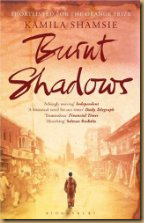
Burnt Shadows - Kamila Shamsie


Some books are meant to be read. Others re-read several times. Burnt Shadows obviously belongs to the latter. I was drawn to the book as bees to nectar ,and emerged out of the Unity bookstall 30 dollars shorter. With such a name one can't go too wrong with picking a book, I argued with the notorious guilt conscience. The prologue had me.

Spanning 5 countries and 6 decades, Burnt Shadows begins where the world as we knew ended, in Nagasaki, on August 9 1945. The day began as a perfectly blue day but only the survivors, among them Hiroko, would associate it with a certain greyness. The greyness clouding the world, when war has removed all the vibrant colors.

War remains at the core of Burnt Shadows, not the horrors of war as you see it happening before you, but picking up from broken shards of a former life, in the aftermath of war itself. Every country that it encompasses, begins at a point when it has been razed down by hatred. Hiroko Tanaka loses her lover, Konrad, a German translator, on that fateful August day and her life changes forever.  Two years later she moves to Delhi, in search of Konrad's estranged half-sister, Iles Weiss(Elizabeth) and her husband, James Burton. Being a born linguist, and not having much to do, she learns Urdu from Sajjad Ashraf, an employee of James and hence, of the Raj. Soon enough, her seemingly quiet life is once again thrown into turmoil as Pakistan is born, and suddenly religion comes to the forefront of issues during Partition.

Displaced once again, the story follows Hiroko into Karachi. Kamila's powerful narrative style is evident as she gives us a glimpse into the lives and loves of her characters as they  brave the heat of Delhi or catch the seashore breeze in Karachi. She brings to light an important fact, that beneath all the religious frenzy dividing the two countries, as even nature did not deem fit, is a fundamental similarity. Kamila's literary creativity is evident in her use of rich metaphors as evident in phrases such as 'hair like black water' to drive a point home. At various points in the book, Kamila reveals that she is a master story teller with her strong plot and deep characters. She could not have chosen better than Hiroko, the Japanese, to try and lift the existing social hierarchy in a class conscious Indian society at the height of the British Raj.

Kamila has accurately captured the sense of imminent fear in the minds of her characters as they propel through the course of history and their lives, in a post 9/11 era, comforting themselves with the phrase 'After the war', only there is no same after. These otherwise fair minded characters, particularly Kim Burton lose all their  sense of justice and morality when it is a question of their nation's security. 

Immigrants have been given their due as all the characters are blasted out of their natural surroundings by the loud cries of war. Even as sorrow, (never regret), pervades the lives of her characters, the colorful descriptions of the numerous flora in the gardens of Delhi, seem to bring relief to them.  Friendships seem to transcend national and religious boundaries. The scenes capturing Ilse and Hiroko's friendship in particular, seem to be a pleasure to read. Sajjad's optimism permeates through the pages of the book and the reader finds himself catching on to it.

Burnt Shadows touches you to such an extent that you can never get over those feelings or the book. It raises some important questions about the world we live in, in the reader's mind, with haunting echoes reiterating, what could have been had, being destroyed forever in the name of war. As Guns & Roses, once sang, 'What is civil about war anyways?'.

Hurry and grab your copy of Burnt Shadows before it is too late.

Book Rating - 4.5/5

Lines from the book that leave an imprint:

"As for justice, it seemed an insult to the dead to think there could be any such thing."
"On dewy mornings the spiders build elaborate webs. Or perhaps the webs only become visible when dew is captured in their threads." 
"The bomb did nothing beautiful."
"But until you see a place you have known your whole life reduced to ash you don't realise how much we crave familiarity."
"...just this easily everything worthwhile in a life can be erased." 
"Muslim fatalism? No. No. Pakistani resignation. It's a completely different thing." 
"The men and women who walk through shadow-worlds in search of the ones they loved. Monsters who spread their wings and land on human skin, resting there, biding their time. The  army of fire demons, dropped from the sky, who kill with an embrace."
"...bodies without skin, bodies with organs on display, bodies that reveal what happens to bodies when nothing in them works any more." 
"We make a desolation and call it peace." 
"War is like a disease. Until you've had it you don't know it."  

If you like this book, you might also like:-

And now that I have left my readers with a heavy heart, it will not be long before I come back with tales of mirth about The Graveyard Book-Neil Gaiman.