Showing posts with label Humour. Show all posts

Sunday, April 25, 2010

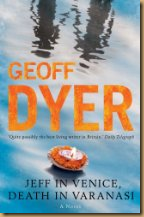
Jeff in Venice, Death in Varanasi – Geoff Dyer

image

Geoff Dyer was one of the authors who charmed the quaint city of Wellington with his presence during the Writers and Readers week a couple of months back. Add to that a catchy title and it was but little wonder that this book soon occupied the grand stands of every book store in Wellington. Not to be left behind I got a copy from the local library and was soon walking through the art galleries of Venice and trying to “find myself” in Varanasi.

Jeff Atman is a freelance journalist who loathes his job (well who doesn’t?), but for the sake of the fine bread and butter on his table goes about writing mindless articles. He lands up with an assignment to cover the Biennale art extravaganza in Venice. Jeff is going through an acute mid life crisis and his self-esteem has reached an extreme low point when he meets Laura, a mind blowing, beautiful woman, who is in Venice to promote the art gallery for which she works. Amidst the pomp and splendour of the Biennale adventure, and a lot of mindless parties Laura and Jeff find themselves enjoying each other (sometimes they even have conversations ;)) to a point of excess. Jeff starts to fall in love with Venice when the spiritual city of Varanasi beckons in the form of another assignment.

After the raucous adventure in Venice, he is confronted with an entirely different experience in the city of Varanasi. Surprisingly Jeff and Varanasi start getting along splendidly with each other and soon he is in search of himself in the crowded streets of Varanasi.

Jeff in Venice, Death in Varanasi is an interesting book written in two parts which, other than the connecting thread called Jeff are entirely different. Geoff’s sense of humour is very apparent all through the book especially his accounts of life in Varanasi. The author deftly switches from third person narrative of events in Venice to a first person narrative in Varanasi. It is symbolic of Jeff’s journey from being a nobody to truly finding peace with himself. Geoff’s descriptions of  Varanasi, although coming from a westerner’s point of view are very accurate.

The part set in Varanasi started to resemble a travel guide of sorts after a while, but Geoff’s British humour more than made up for it. After some graphic descriptions of sex scenes in Venice, their absence was a bit conspicuous in Varanasi but they seem to go well with Jeff’s spiritual journey.

Jeff is Venice, Death in Varanasi is a good choice if you are looking for a book to crack up on but the reader has to be a bit patient in Varanasi.

Book Rating – 3.75/5

Book Stats:-
No. of Pages:- 296;
Year Published:- 2009;
Publisher:- Cannongate Books Ltd;
Book Setting:- Venice;Varanasi
Reading dates:- 10/Apr/2010 - 16/Apr/2010

Laughable Lines:-

“Anand was completely wrong about driving in  Varanasi. The traffic is not terrible at all. It is beyond any idea of terribleness. It is beyond any idea of traffic.”
You need three things if you are driving in Varanasi. Good horn, good brakes and good luck.”
Even the fake holy men- and I’d been warned by Jamal, that many of them were wholly fake – were genuine.

If you like this, you might also be interested in:-

image

After all the flamboyance of Venice and the hustle and bustle of Varanasi, join me in a ride through 18th century France in my upcoming review of Perfume:The Story of a murderer by Patrick Suskind.

Sunday, March 28, 2010

Juliet, Naked - Nick Hornby

Juliet, Naked was one the suggestions that came up on the librarything site for Her Fearful Symmetry and I immediately got a copy from the local library. I got latched on to the book pretty fast ,  this being my first Nick Hornby selection, but, unfortunately my great enthusiasm fizzled out after the initial few chapters. But it did provide me some much-needed laughter after The Piano Teacher debacle.

Juliet, Naked starts off in a little English seaside town called Gooleness. Duncan, a man obsessed with the work of former singer and songwriter, Tucker Crowe, lives in Gooleness with his partner of fifteen years, Annie. Duncan who does not have much to show for his own life, spends it fervently spinning conspiracy theories about Crowe's life (or what there was of it from a different era), with a few of his internet buddies, Crowologists as they call themselves. As the story progresses, Annie and Duncan start examining the pointlessness of their relationship, where Tucker always seems to be lurking as an invisible presence.

Just when the reader starts warming up to the character of Duncan, he is completely pushed aside by Annie and the story starts to weave around Annie. Exit Duncan; Enter Tucker and then the reader cruises through parts of the U.S., following the life of Tucker. Duncan soon becomes a shadow while Annie enters centre stage, with her trivial crush on Tucker looming into something more dangerous and serious.
I found the character of Annie quite insipid and pretentious, exhibiting an intellect and taste for music that she very well did not possess. The Duncan/Annie pair did remind me of the  couple, Martin and Marijke from Her Fearful Symmetry, although M&M were far more interesting. If Nick had stuck to Duncan's character throughout the story, it might have made for an interesting book. The title and the beginning of the book seem to suggest some serious insights to be gained into the nature of relationships but these are soon reduced into banal trivialities. Just when the reader is about to give up on the book entirely, Nick tries to win back his/her interest with all the drama surrounding Tucker's enigmatic albeit colourful past.

All is not lost with the book as there are some places where the reader truly enjoys a good laugh. The chracter of Jackson, Tucker's son, soon wins over one's heart and as with any child, one is taken in by his innocence and the hundred questions he keeps firing back at adults.

Juliet, Naked is definitely not a great book, but might be a safe bet for that long flight haul.

Book Rating - 3/5

Book Stats:-
No. of Pages:- 249; 
Year Published:- 2009; 
Publisher:- Penguin Books
Book Setting:- UK, US; 
Reading dates:- 26/Mar/2010 - 27/Mar 2010

Similar book(s) that you might be interested in:-

Do you have a flair for some thrilling action and high drama? The Patriot's Club - Christopher Reich, my next review, is just what you are after.

Saturday, March 20, 2010

The Graveyard Book - Neil Gaiman

I was walking past rows and rows of books at the Unity bookstall when this tiny illustrated book almost called out to me. Thinking, the lack of sleep was starting to have it's effects, I walked on. But this time the "Tssss. I am here", was loud and clear. For someone who is a book romantic, being accosted by one was a sure sign that The Graveyard Book should make it to my bookshelf.

With a name like 'The Graveyard Book', it would have been tossed aside by most readers as too 'grave' a book, but not so when the author is Neil Gaiman. Give Neil Gaiman a graveyard, a kid called Nobody Owens, the Jack(s)-of-all-trade(s), and right before your very eyes, he has concocted a delicious masterpiece of children's literature fit for consumption by all ages.

The Graveyard Book follows the course of Nobody Owens' life as he lives among the dead in a graveyard in Scotland. Having lost his family to some vicious elements, Nobody, Bod for short is left at the mercy of the dead at the nearby graveyard, who take him into their fold. The story twists and turns with beautiful illustrations in between, and as the reader nears the end, the element of suspense and drama makes one impatient to get to the last page.

The best part about The Graveyard Book is that it is written from a child's perspective, a child with a curiosity so typical of a five year old, one who is not afraid of asking questions, a little kid who does not fully comprehend the world around him and yet, instinctively knows right from wrong. Neil Gaiman's vivid imagination is at play as he describes Bod's fading acts and his rare encounters with the world at large. The character of Silas would tend to be an instant hit with most of the readers. The book has a touch of that dark insidious British humour that makes your stomach churn and yet, funnily enough, at other times, makes you laugh away your fears. Gaiman has made his readers notice the paradigm shift when you live the story through the dead, becoming curiously ironical when your night-to-night affairs are conducted in a graveyard. 

The friendship between Scarlet and Bod has been brought to life in a rather interesting manner although I would have liked for Gaiman to devote more pages to it. The reader is not aware of the setting of the graveyard till he/she is halfway through the book and it would have added to the interest element of the story to give a more detailed description of the graveyard in the beginning. But other than these minor points, The Graveyard Book is the perfect book to indulge in with your ten year old. I think the audio book, with Gaiman's lucid reading of the book, might also be worth giving a shot at.

Book Rating - 4/5

Delightful quotes from the book:

"A graveyard is not normally a democracy and yet death is a great democracy,..."
"You are obvious boy. You are difficult to miss. If you came to me in company with a purple lion, a green elephant, and a scarlet unicorn astride which was the King of England in his Royal Robes, I do believe that it is you and you alone that people would stare at, dismissing the others as minor irrelavancies."
"When glances naturally slip from you, you become very aware of eyes upon you, of glances in your direction, of attention."

If you like this book, you might also like:-
The Book Theif - Marcus Zusak

After that delightful read of The Graveyard Book at Scotland, I want to give my readers a taste for the art and culture of Vienna. Join me on the travails of The Piano Teacher by Elfriede Jelinek coming up next.

Monday, March 8, 2010

The Buddha of Suburbia - Hanif Kureishi


The Buddha of Suburbia is the third book by Hanif Kureishi that I have read. I was not very impressed with Kureishi's books in the past but I went ahead and picked up this book as it was part of the 1001 books list and I had heard some rave reviews about it. For those of you who are unfamiliar with the 1001 books, it is an evolving list of some great books spanning 3 centuries, including some of the contemporary titles. I am slowly getting used to Kureishi's writing style but this book did seem to be a let down.

The protagonist in the Buddha of Suburbia is Karim, a disillusioned teenager living in a dingy London suburb. Being the son of a an Indian Muslim father and an English mother, he feels trapped in a world he does not fully comprehend. He is in awe with the London lifestyle and believes his liberation lies in getting there. Meanwhile his father has taken to the eastern philosophies of yoga and meditation and is charming his way through the minds of the confused suburbans.

Kureishi has touched upon some very immoral themes in this book ,with a certain callousness that can leave the reader a bit bemused but far more confused. His characters live in a state of constant squalor that can even go as far as disgusting at times. The story seemed to simply drift from the suburbs to the city as did the characters. There was a wide ensemble of characters but all the characters lacked a certain punch.

There was also an underlying contradiction in the novel. Karim, although, born in England to an English mother seemed to associate more with his Indian self. He believed himself to be an Indian immigrant rather than one of the English. Considering his half-English origins, bundled with the fact that he had never set foot in India would have quite easily disqualified him from the immigrant status. But Kureishi made him out to be the unfortunate immigrant and the tale told through an immigrant's perspective.

To do the book some justice, I need to mention that the irreverent humour, at places, did seem to truly make me laugh. Kureishi handled Karim's transformation from the role of observer as he tramps along the suburbs, to observed as he frolics along the streets of London, quite well.

The book is really not worth your while. But if you have heard of Hanif Kureishi and would like to try his books, then this is probably a better bet.

Book Rating - 2.5/5

The Little Stranger by Sarah Waters is the next review steaming in the  background. So don't miss out on it. 

Saturday, March 6, 2010

The Great Indian Novel - Shashi Tharoor

There is always an interesting story behind how one comes to pick up a certain book. Sometimes books reach out to you, sometimes you wander over the library enclosure and pick up a certain book, presumably because the cover looks attractive. At other times you may meet midnight chat buddies (your midnight, not necessarily theirs) over facebook and they may urge you into picking up a book. So enthusiatic did she sound that a couple of days later I had procured the book from the local library (Wellington City Library). I sure was in for a joy ride.  

This is an interesting satire morphing the characters from the ancient Indian epic, "Mahabharatha" onto colonial and post colonial India. Even the name of the book is a pun on the ancient epic.  The author deftly switches between the ancient times and the days of the Raj twisting details from the past to make them fit into the present. His literary skills are highlighted as he makes use of allegory and seemingly innocuous puns during the recounting of the tale. The author's vivid imagination is apparent as he has gone about the task of mapping the characters between the past and the present. The book spans different ages and characters despite which,  the author has managed to capture the reader's interest throughout this fast paced, open-ended allegory.

One of the interesting aspects of the book is the character guessing game that the reader can indulge in, while, avidly perusing the book. Even for someone with limited knowledge of Indian politics, the characters of Gandhi, in the guise of the mild mannered and idealistic Bhishma Pithamaha and Nehru, his partner in (non-violent) crime potrayed by the well-educated yet blind Dhridhurashtra, should be quite obvious. His choice of narrator, the wise sage, Ved Vyas (C.Rajagopalachari) could not have been better.

On the flip side, the relevance of characters such as Arjuna and his younger brothers can definitely be questioned.

The title of the book can seem a bit daunting. Afterall such a mighty title would conjure up images of a serious, dense book, but the book is anything but. Humour, something one does not associate much with the earnest Indian diaspora, spins it's magic through the tale much like the Khadi clothing that Gandhi advocated.

I would urge anyone looking out for an interestingly humourous book, with clever plots and colourful characters to pick a copy of this book. Do not let your knowledge, or lack of thereof, of the ancient epic or Indian politics stop you from taking the plunge into this book. You sure won't regret the good laughs.

Book Rating 4.5/5 

If you like this book you might also like:-
Keep an eye out for my next review - The Buddha of Suburbia - Hanif Kureishi